
September 11, 2026

GTM Engineer Salary: How Much Do GTM Engineers Make?
September 3, 2026
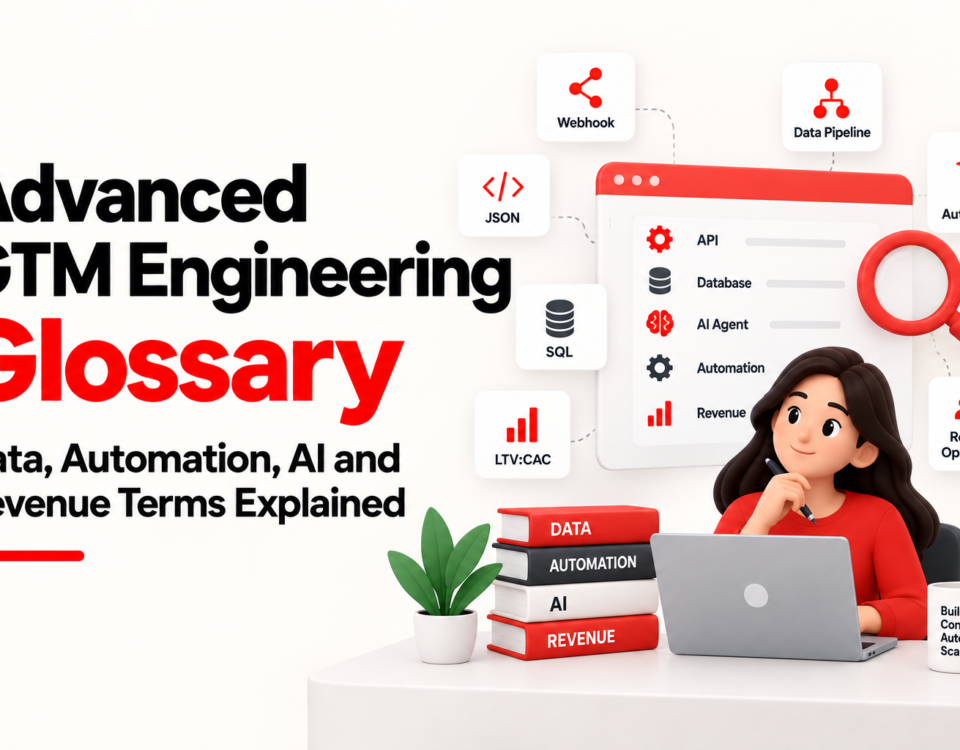
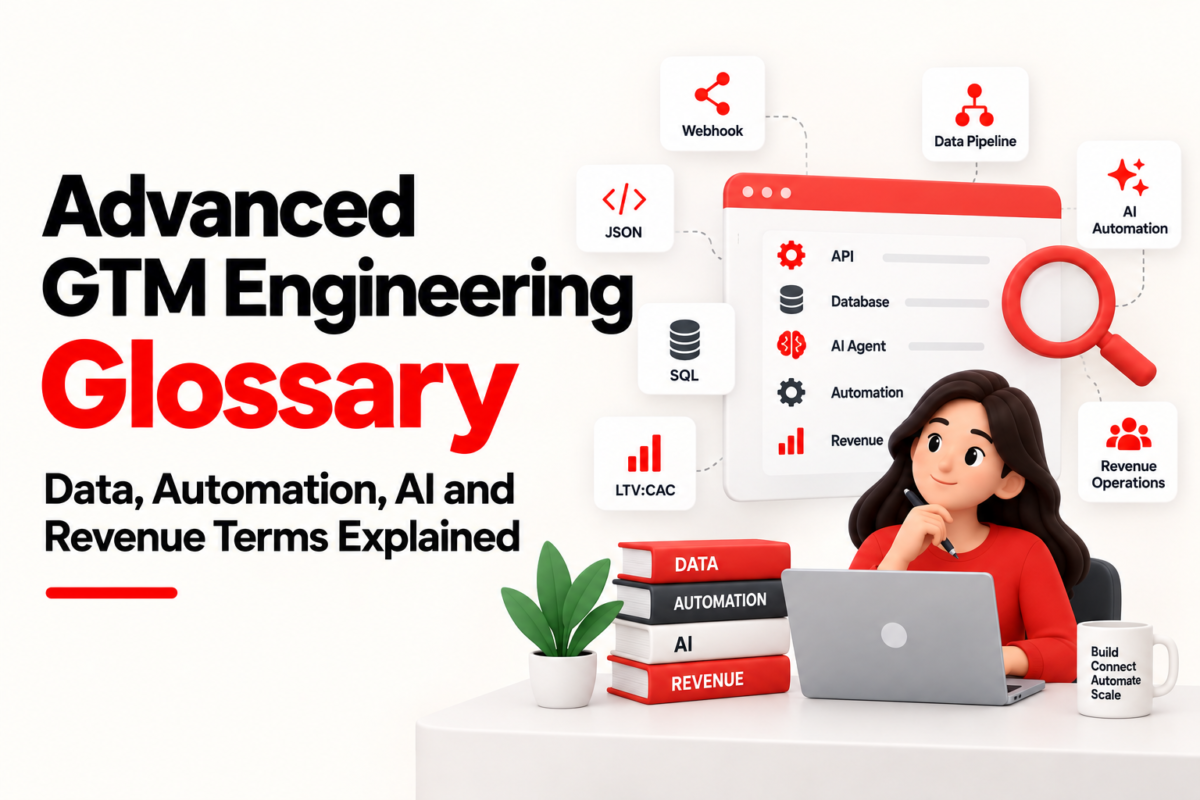
GTM Engineering Glossary: 50+ Terms Every Beginner Should Know
September 11, 2026GTM Engineer Salary: How Much Do GTM Engineers Make?
September 3, 2026GTM Engineering Glossary: 50+ Terms Every Beginner Should Know
September 11, 2026GTM Engineering Glossary: 50+ Terms Every Beginner Should Know
Table of Content
- What Are GTM Terms?
- GTM Strategy and GTM Operations Terms
- Market and Targeting Terms
- Lead and Prospecting Terms
- Data and Enrichment Terms
- Intent and Buying Signal Terms
- Lead Management Terms
- Lead Qualification Stages
- Outbound and Outreach Terms
- SaaS and Business Growth Terms
- How Do These GTM Engineering Terms Connect Together?
- Final Thoughts
- Other Blogs
If you are new to GTM Engineering, one of the first things that can feel confusing is the number of terms used in the industry.
You start hearing words like ICP, TAM, enrichment, orchestration, buying signals, lead routing, MQL, SQL, and ABM. At first, it can feel like everyone is speaking a completely different language.
The good news is that most of these terms are much simpler than they sound. Once you understand what each one means and where it fits into the Go-To-Market process, GTM Engineering becomes easier to understand.
This GTM Engineering glossary covers the most important terms every beginner should know. The goal is simple: when you see a GTM term, you should understand what it means without searching for a complicated definition.
What Are GTM Terms?
GTM terms are the words and concepts used to describe how companies find the right customers, collect and organize data, generate leads, run campaigns, and move potential customers through the sales process.
For example, a company first needs to understand its market. Then it identifies its ideal customers, finds the right companies, enriches their data, looks for buying signals, scores the leads, and starts outreach.
A GTM Engineer often helps build the systems behind this entire process.
This GTM Engineering glossary for beginners helps you understand how these terms connect throughout the GTM process.
GTM Strategy and GTM Operations Terms
1. GTM Strategy
GTM Strategy stands for Go-To-Market Strategy. It is the overall plan a company uses to reach its target customers and sell its product or service.
It answers important questions such as who the company wants to sell to, what problem it solves, and how it will reach potential customers.
In simple words:
GTM Strategy = Who you sell to + What you sell + How you reach them + How you convert them.
2. GTM Motion
A GTM Motion is the specific approach a company uses to acquire customers.
For example, a company may use a sales-led motion, product-led motion, inbound motion, outbound motion, or founder-led sales.
The strategy is the overall plan, while the GTM motion is the approach used to execute that plan.
3. GTM Execution
GTM Execution means actually implementing the strategy.
Creating an ICP is part of planning. Finding companies, researching contacts, enriching data, and running outreach campaigns are examples of execution.
A GTM strategy only becomes valuable when the company can execute it properly.
4. GTM Workflow
A GTM Workflow is a step-by-step process used to complete a GTM activity.
For example:
Find companies → Find decision-makers → Enrich data → Validate emails → Score leads → Send qualified leads to the CRM.
This complete process is a GTM workflow.
GTM Engineers often build, automate, and improve these workflows.
5. GTM Automation
GTM Automation means using technology to automatically perform repetitive Go-To-Market tasks.
Instead of manually moving information from one tool to another, an automated workflow can handle the process.
For example, when a new company is added to a database, the system could automatically enrich the company, find relevant contacts, validate emails, and send qualified leads to a CRM.
6. GTM Orchestration
GTM Orchestration means coordinating multiple tools, data sources, and workflows so they work together as one system.
Automation can complete a specific task. Orchestration focuses on how multiple processes and systems connect.
For example, your CRM, enrichment platform, automation tools, email platform, and sales team may all need to work together.
7. GTM Infrastructure
GTM Infrastructure is the technical foundation behind a company’s Go-To-Market activities.
It can include CRMs, databases, integrations, automation workflows, reporting systems, and data processes.
You can think of GTM infrastructure as the system working behind the scenes to support sales and marketing teams.
8. GTM Tech Stack
A GTM Tech Stack is the collection of tools a company uses to run its Go-To-Market activities.
A company might use different tools for prospecting, enrichment, CRM management, automation, outreach, and reporting.
The tools may change, but the goal is always to help GTM teams work more efficiently.
Market and Targeting Terms
9. ICP
ICP stands for Ideal Customer Profile.
It describes the type of company that is most likely to benefit from your product and become a valuable customer.
For example, a company selling sales software may define its ICP as B2B SaaS companies with 50–500 employees that have an outbound sales team.
ICP focuses on the company.
10. ICP Mapping
ICP Mapping is the process of identifying and organizing the characteristics of companies that match your Ideal Customer Profile.
You might use filters such as industry, company size, revenue, location, technology, or growth stage.
The goal is to clearly understand which companies should be targeted.
11. Buyer Persona
A Buyer Persona represents the type of person involved in buying your product.
For example, your ICP may be B2B SaaS companies, while your buyer persona could be a Founder, Head of Sales, or VP of Marketing.
The easiest way to remember the difference is:
ICP = Which company?
Buyer Persona = Which person inside that company?
12. TAM
TAM stands for Total Addressable Market.
It represents the total possible market opportunity for your product or service.
In simple terms, TAM answers:
If every possible customer bought our product, how large could the market be?
It represents the broadest market opportunity.
13. SAM
SAM stands for Serviceable Addressable Market.
It represents the part of the total market that your company can actually serve.
For example, your TAM may include companies worldwide, but your product may currently only support specific markets or languages.
That smaller group would be closer to your SAM.
14. SOM
SOM stands for Serviceable Obtainable Market.
This represents the realistic portion of the market that your company can actually capture.
A company may technically be able to serve thousands of customers, but realistically, it cannot win all of them.
SOM focuses on the realistic opportunity available to the business.
15. TAM Mapping
TAM Mapping is the process of identifying and organizing the companies that exist within your potential market.
Instead of simply estimating that your market contains 10,000 companies, you try to identify those actual companies.
This data can then be used for targeting, segmentation, and outbound campaigns.
16. Market Segmentation
Market Segmentation means dividing a large market into smaller groups based on shared characteristics.
Companies may segment their market based on industry, size, geography, revenue, or business model.
Segmentation helps teams create more relevant campaigns and messaging.
17. Account Segmentation
Account Segmentation means dividing target companies into different groups.
For example, accounts might be divided into enterprise, mid-market, and small-business segments.
This helps sales and marketing teams prioritize accounts differently.
18. Target Account
A Target Account is a specific company that your business wants to sell to.
Once a company matches your ICP and your team decides to actively pursue it, that company becomes a target account.
Target accounts are especially important in Account-Based Marketing.
Lead and Prospecting Terms
19. Lead
A Lead is a potential customer whose information has entered your system.
The person may have filled out a form, attended an event, downloaded content, or been identified through outbound prospecting.
A lead does not necessarily mean the person is ready to buy.
20. Prospect
A Prospect is usually a potential customer who has been identified as relevant to your business.
For example, you may have thousands of contacts in a database, but only a smaller group matches your ICP.
Those relevant contacts can be considered prospects.
21. Lead Generation
Lead Generation is the process of finding or attracting potential customers.
This can happen through SEO, content marketing, paid advertising, events, referrals, or outbound campaigns.
The goal is to create a pipeline of potential customers.
22. Lead Sourcing
Lead Sourcing means finding leads from specific sources.
These sources could include databases, LinkedIn, websites, events, or other platforms.
Lead sourcing is commonly used in outbound GTM workflows.
23. Prospecting
Prospecting means actively searching for potential customers.
It usually involves finding companies that match your ICP and identifying the right people within those companies.
Data and Enrichment Terms
24. Data Enrichment
Data Enrichment means adding additional information to existing data.
For example, you may only have a person’s name and company. Enrichment can add information such as job title, company size, industry, or location.
The purpose is to make data more useful.
25. Lead Enrichment
Lead Enrichment specifically means adding more information about an individual lead.
You may start with a name and email address. After enrichment, you may also know the person’s job title, company, location, and other relevant information.
26. Account Enrichment
Account Enrichment focuses on improving information about a company.
It can include company size, industry, revenue, funding, technology, or growth information.
This helps teams determine whether an account matches their ICP.
27. Contact Enrichment
Contact Enrichment focuses on an individual person.
For example, you may want to confirm their job title, department, seniority, or professional profile.
This helps ensure you are reaching the right person.
28. Data Validation
Data Validation means checking whether data is accurate and usable.
For example, email validation can help determine whether an email address is likely to be valid.
Validation helps improve data quality before launching campaigns.
29. Data Deduplication
Data Deduplication means identifying and removing duplicate records.
The same person may appear multiple times in a CRM because data came from different sources.
Deduplication helps keep the database clean.
30. Sales Intelligence
Sales Intelligence refers to information that helps sales teams understand potential customers.
This may include company information, employee changes, funding activity, technology usage, hiring, or other business insights.
The goal is to help sales teams make better decisions.
Intent and Buying Signal Terms
31. Buying Signal
A Buying Signal is an action or change that may suggest a company is more likely to buy.
For example, a company hiring a large sales team may be relevant to a business selling sales software.
Buying signals do not guarantee a purchase, but they can help prioritize accounts.
32. Intent Data
Intent Data refers to information that may indicate interest in a specific topic or solution.
For example, a company researching a particular business problem may be actively looking for ways to solve it.
Intent data can help GTM teams prioritize accounts.
33. Trigger Event
A Trigger Event is a specific event that creates a reason for outreach.
Examples include funding announcements, leadership changes, new product launches, hiring activity, or market expansion.
Trigger events can make outreach more relevant because there is a clear reason for contacting the company.
Lead Management Terms
34. Lead Scoring
Lead Scoring means assigning a score to a lead based on specific criteria.
A lead may receive points based on company fit, job title, website activity, or buying signals.
Higher-scoring leads are generally given higher priority.
35. Account Scoring
Account Scoring is similar to lead scoring, but it focuses on companies.
A company may receive a higher score because it strongly matches the ICP or shows relevant signals.
36. Lead Qualification
Lead Qualification is the process of deciding whether a lead is a good potential customer.
The criteria may include fit, need, authority, budget, or level of interest.
The exact qualification process can be different for every company.
37. Lead Routing
Lead Routing means sending a lead to the right person or team.
For example, enterprise leads may go to one sales team, while smaller companies go to another.
Automation can make lead routing faster and more accurate.
Lead Qualification Stages
38. MQL
MQL stands for Marketing Qualified Lead.
It usually refers to a lead that marketing considers more likely than an average lead to become a customer.
However, every company can define MQL differently.
39. SQL
SQL stands for Sales Qualified Lead.
An SQL is generally a lead that has been qualified for further sales activity.
The lead is usually considered more ready for direct sales engagement.
40. PQL
PQL stands for Product Qualified Lead.
This term is commonly used by product-led companies.
A PQL is a person who has used a product and demonstrated behavior that suggests they may be ready to upgrade or buy.
41. Lead Lifecycle
The Lead Lifecycle describes the journey of a potential customer through different stages.
A person may start as a lead, become qualified, speak with sales, become an opportunity, and eventually become a customer.
42. Lead Nurturing
Lead Nurturing means building relationships with potential customers who are not ready to buy yet.
This can happen through educational content, emails, follow-ups, or other communication.
The goal is to stay relevant until the timing is right.
Outbound and Outreach Terms
43. Outbound Sales
Outbound Sales means proactively contacting potential customers.
Instead of waiting for customers to discover your company, your team identifies relevant prospects and reaches out to them.
44. Cold Outreach
Cold Outreach means contacting someone who has not previously interacted with your business.
The person may match your ICP, but they did not directly request information from you.
45. Sales Sequence
A Sales Sequence is a planned series of outreach activities.
For example:
Day 1 → Email
Day 3 → Follow-up
Day 6 → Another message
Day 10 → Final follow-up
Sequences help teams maintain consistent follow-ups.
46. Personalization at Scale
Personalization at Scale means making outreach relevant while communicating with a large number of prospects.
Instead of manually researching every company, GTM workflows can automatically collect useful information to help personalize outreach.
The goal is to balance personalization and efficiency.
47. ABM
ABM stands for Account-Based Marketing.
Instead of marketing broadly to a large audience, ABM focuses on specific high-value target accounts.
Sales and marketing teams may work together to create personalized campaigns for those companies.
SaaS and Business Growth Terms
48. B2B
B2B stands for Business-to-Business.
It refers to a business that sells products or services to other businesses instead of directly selling to individual consumers.
For example, a company selling CRM software to other companies is a B2B business.
Many GTM Engineering workflows are designed for B2B companies because they involve identifying target accounts, finding decision-makers, enriching data, and running outreach campaigns.
49. MRR
MRR stands for Monthly Recurring Revenue.
It represents the predictable revenue a company expects to generate every month from recurring subscriptions.
For example, if a SaaS company has 100 customers paying $100 per month, its MRR would be:
100 × $100 = $10,000 MRR
MRR is commonly used by SaaS and subscription-based businesses to measure monthly business growth.
50. ARR
ARR stands for Annual Recurring Revenue.
It represents the predictable recurring revenue a company expects to generate in a year.
For subscription businesses, ARR is commonly calculated by multiplying MRR by 12.
For example:
$10,000 MRR × 12 = $120,000 ARR
ARR helps companies understand their recurring revenue on an annual basis.
51. Series A
Series A is a stage of startup funding.
At this stage, a startup has usually demonstrated that its product or business model has potential and is looking to grow further.
The funding may be used to expand the team, improve the product, acquire more customers, or develop the company’s Go-To-Market strategy.
For GTM teams, Series A companies can be interesting because they are often actively investing in growth.
52. Series B
Series B is a later stage of startup funding focused on scaling the business.
At this stage, the company may already have an established product, customers, and some level of market traction.
The company may use the funding to expand into new markets, hire more employees, grow sales and marketing teams, or scale its operations.
Series B funding can also be a useful buying signal for companies selling products or services that support business growth.
53. Series C
Series C is a later-stage funding round typically associated with business expansion and scaling.
Companies at this stage may use funding to enter new markets, develop new products, make acquisitions, or expand internationally.
For GTM teams, Series C companies may have larger budgets, more established teams, and more complex Go-To-Market operations.
54. Prospect
A prospect is a potential customer who may be a good fit for your product or service.
Unlike a general contact, a prospect is usually someone who matches your Ideal Customer Profile (ICP) and has the potential to become a customer.
For example, if you sell a GTM automation tool to B2B SaaS companies, a Founder or Head of Sales at a SaaS company that matches your ICP could be considered a prospect.
In GTM Engineering, identifying the right prospects is an important part of building high-quality lead lists and running effective outbound campaigns.
How Do These GTM Engineering Terms Connect Together?
The easiest way to understand all these terms is to see them as one connected process.
A simplified GTM workflow may look like this:
Market → TAM → ICP → Target Accounts → Prospecting → Data Enrichment → Data Validation → Buying Signals → Lead Scoring → Qualification → Lead Routing → Outreach → Lead Nurturing → Opportunity → Customer
Not every company follows this exact process.
However, it helps you understand where each GTM term fits into the larger picture.
A GTM Engineer often works behind the scenes to make these processes more efficient. They connect data sources, automate repetitive work, improve data quality, and help the right information reach the right team.
Final Thoughts
GTM Engineering can initially feel confusing because it combines concepts from sales, marketing, operations, data, and technology.
But once you understand the foundational terms, the bigger picture becomes much easier to understand.
You do not need to memorize every term immediately. Start with the most important ones: GTM Strategy, ICP, TAM, prospecting, enrichment, automation, buying signals, lead scoring, and outbound sales.
As you continue learning GTM Engineering, you will see these terms repeatedly.
The difference is that instead of feeling confused when you see ICP Mapping, enrichment, orchestration, MQL, or ABM, you will understand what they mean and where they fit into the GTM process.
This GTM Engineering glossary is a starting point for understanding the language, workflows, and systems behind modern Go-To-Market teams.
FAQs
1What are the most important GTM terms for beginners?
Some of the most important terms include ICP, TAM, SAM, SOM, prospecting, data enrichment, buying signals, lead scoring, GTM automation, and GTM orchestration.
2What is GTM Automation?
GTM Automation means using technology and workflows to automatically perform repetitive Go-To-Market tasks, such as enrichment, lead routing, data updates, and CRM workflows.
3What is the difference between a lead and a prospect?
A lead is generally a potential customer whose information is available in your system. A prospect is usually a more relevant potential customer who fits your targeting criteria.
Other
Blogs
September 3, 2026
Published by Shivani on September 3, 2026
Categories